
$800 Million in “Invisible” Oil: Sanctioned Tankers Use Fake Signals to Slip Iranian Crude Past U.S. Pressure
A covert shipping network is moving Iranian crude worth up to $800 million by turning the global vessel-tracking system into a smokescreen, even as Washington intensifies efforts to choke off Tehran’s oil revenues.
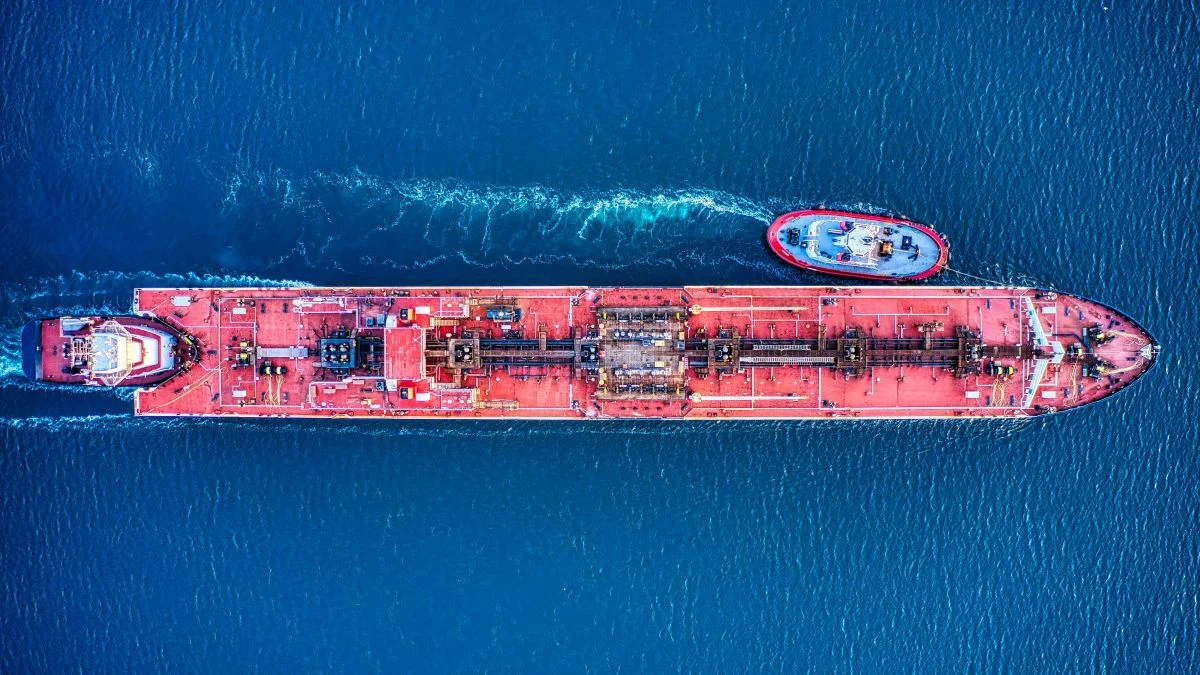
Representative image of an oil tanker in the Persian Gulf region
Maritime analytics firm Windward AI has identified a group of sanctioned tankers that appear—on paper—to be anchored near Iraqi ports, while in reality operating out of Iran. The discrepancy is not accidental: it is engineered through deliberate manipulation of AIS (Automatic Identification System) data, the backbone of maritime transparency.
At least four very large crude carriers (VLCCs) are central to the operation. With a capacity of roughly two million barrels each, they can collectively transport around eight million barrels of oil—cargo valued at approximately $800 million depending on market prices. The scale suggests a systematic workaround rather than isolated violations.
Turning AIS into cover
The method relies on creating a believable—but false—digital footprint:
- Ships broadcast coordinates placing them near Basrah in Iraq
- Destination signals list Iraqi ports
- Physical movements instead route them to Iranian loading points
This produces what analysts describe as a “digital alibi,” allowing vessels to pass initial compliance checks while conducting sanctioned trade out of sight.
Operating in the world’s busiest oil corridor
The activity has been concentrated west of the Strait of Hormuz, a critical artery for global energy flows. Heavy traffic in the area provides natural cover, making anomalous movements harder to isolate in real time.
The timing aligns with a renewed push from the U.S., led by Donald Trump, to maintain maritime pressure on Iran as part of broader demands over its nuclear program. Tehran has rejected calls to halt uranium enrichment, leaving enforcement measures and evasion tactics escalating in parallel.
A shifting battlefield: from ships to data
The episode highlights a deeper shift in sanctions enforcement. Control is no longer just about physical interdiction at sea—it is increasingly about data integrity. Systems designed to ensure transparency, such as AIS, are now being exploited as tools of concealment.
For regulators and market participants, this creates a structural challenge: detecting illicit oil flows now requires cross-referencing multiple intelligence layers, from satellite imagery to behavioral tracking.
For the market, the implication is simpler—despite tighter restrictions, sanctioned barrels are still entering circulation, and at a scale large enough to matter.
Based on maritime intelligence data from Windward AI